Most people choose garden fencing by looking at it from the front.
After years installing and repairing fences, I tend to think about what happens when the wind hits the back.
That matters more than many homeowners realise.
A six-foot fence creates a surprisingly large surface for wind to push against. Put several panels together along an exposed boundary and you’re effectively building a wall. If the posts, foundations and fence design aren’t suited to the site, something eventually has to give.
It’s one reason homeowners searching for fencing near me shouldn’t choose panels purely because they like how they look. Wind exposure, ground conditions and the position of neighbouring buildings can matter just as much as appearance.
I’ve seen expensive fencing flattened while much older fencing two streets away stayed perfectly upright.
Usually there’s a reason.
Solid Fencing Takes the Full Force
Traditional solid fencing has plenty going for it.
Featheredge is still one of my preferred systems for many gardens. Installed properly, it’s strong, straightforward to repair and works well with both traditional and modern properties.
Closeboard panels can be excellent too.
But solid fencing catches wind.
There’s no getting around that.
When a strong gust hits a six-foot solid boundary, the force has to travel somewhere. It passes through the boards and rails into the posts, then down into the foundations.
That’s why post depth matters so much.
For a typical domestic fence, around 600mm is often a sensible starting point. On exposed sites, taller boundaries or difficult ground, I’ll sometimes want considerably more.
I’ve removed failed fences where posts were barely 400mm into the ground.
They stood perfectly well during normal weather.
Then a storm arrived.
The storm got blamed. Personally, I’d blame the shallow holes.
Some Gardens Need Airflow
One thing I see often on local jobs is fencing being replaced like-for-like without anyone asking why the original fence failed.
That’s a missed opportunity.
If a solid fence has repeatedly suffered storm damage, installing another identical system with identical foundations might simply restart the clock.
Sometimes allowing air through the boundary makes more sense.
Hit-and-miss fencing is useful here.
Boards alternate on either side of the rails, leaving controlled gaps for air to pass through while still providing a good degree of privacy.
It doesn’t eliminate wind loading completely.
Nothing does.
But it can reduce the pressure compared with a completely solid surface.
For exposed gardens, that can make a meaningful difference.
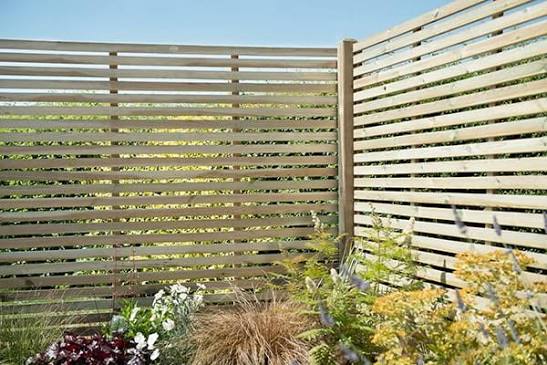
Slatted Fencing Isn’t All The Same
Slatted fencing has become extremely popular.
You see it on new landscaping projects, garden offices, contemporary extensions and increasingly on ordinary suburban properties.
I understand why.
It looks clean.
It works particularly well with modern paving and planting.
But I’ve become slightly wary of people describing every slatted fence as “wind resistant”.
It depends entirely on the design.
Wide gaps between narrow boards allow plenty of airflow.
Tiny decorative gaps between broad boards don’t.
Some slatted systems are effectively solid fences wearing fashionable clothes.
If wind resistance is the reason you’re choosing slatted fencing, look at the actual amount of open space rather than the name of the product.
A decent fencing contractor should consider the whole system – boards, rails, posts, spacing and foundations.
One component alone tells you very little.
Wind Doesn’t Behave Neatly Between Houses
This catches homeowners out.
A garden doesn’t need to overlook open countryside to experience strong wind.
Buildings channel air.
Narrow gaps between houses can accelerate gusts. Corners create turbulence. Extensions alter airflow. Removing a mature hedge can suddenly expose fencing that spent twenty years protected from prevailing winds.
I’ve visited gardens where one section of fence repeatedly fails while everything else remains solid.
Stand there on a windy day and you quickly understand why.
The problem isn’t necessarily the fence.
It’s where the fence sits.
That’s why quoting fence installation purely from measurements and photographs has limitations.
Sometimes you need to stand in the garden.
Yorkshire Ground Conditions Add Another Problem
Wind above ground is only half the equation.
What’s happening underneath matters just as much.
Across Leeds and the surrounding areas, heavy clay is common. It holds water during prolonged wet periods, then contracts during dry weather.
That movement happens around fence foundations year after year.
A well-installed post should cope.
A marginal installation gradually loosens.
Once the concrete footing begins moving, the fence effectively gains a hinge below ground.
Wind then makes the problem worse.
You might notice a gate becoming difficult to latch first. Perhaps one panel starts rattling more than the others.
Then the top of the fence develops a slight lean.
By the time someone starts searching for fence repair near me, the movement may have been developing for months.
Taller Doesn’t Automatically Mean Better
Privacy remains one of the biggest reasons people replace garden fencing.
I understand that completely.
Modern housing can feel incredibly overlooked.
But increasing fence height also increases the area exposed to wind.
That needs accounting for.
You can’t always take a system designed around a four-foot boundary, make it six feet tall and expect everything underneath to behave the same way.
Posts may need changing.
Foundations may need changing.
Panel construction might need changing.
Planning restrictions can also apply depending on where the fence sits, so height shouldn’t be treated casually.
Sometimes planting provides the extra privacy more effectively anyway.
A strong fence combined with sensible shrubs can feel much less enclosed than an enormous solid barrier.
Concrete Posts Aren’t Indestructible
Concrete posts are extremely useful in exposed gardens.
They don’t rot and they can provide excellent long-term support.
They can still fail.
I’ve seen concrete posts crack near ground level because movement in the foundation placed them under repeated stress.
I’ve also seen perfectly good posts leaning because the concrete around them wasn’t substantial enough.
Materials can’t compensate indefinitely for poor groundwork.
This is a recurring theme in fencing.
People spend heavily on what they can see and save money on what disappears underground.
I’d rather have a straightforward fence with excellent foundations than an expensive fence sitting on inadequate posts.
Every time.
Composite Fencing Still Needs Proper Support
Composite fencing gets marketed heavily around durability.
That’s fair to a point.
It removes many traditional timber problems. There’s no annual staining and the boards won’t rot in the same way.
But composite fencing cost is significantly higher, and it would be a mistake to assume expensive boards automatically create a stronger boundary.
Wind still pushes against them.
Posts still carry the load.
Foundations still matter.
Some composite systems are quite heavy too, which adds another consideration.
Then there’s thermal movement. Composite expands and contracts differently from timber, so installers need to follow the correct spacing and fixing methods.
I’ve seen premium materials installed badly.
They still fail.
Hedges Can Be Excellent Windbreaks
People sometimes assume removing a hedge and replacing it with fencing will make a garden easier to maintain.
It often does.
But the garden can become noticeably windier afterwards.
A hedge filters wind rather than stopping it completely.
Air moves through the foliage and loses energy.
A solid fence behaves differently. Wind hits the surface, moves upwards and around it, and can create turbulence on the sheltered side.
That doesn’t mean hedges are better than fences.
They’re different tools.
In some exposed gardens, combining planting with fencing gives excellent results.
The fence creates security and privacy while shrubs help break up wind before it reaches the panels.
Autumn Is When Weaknesses Start Showing
Late summer and early autumn are good times to inspect exposed fencing.
Don’t wait for the first named storm.
Walk along the boundary and push each post firmly.
Look along the top line.
Check gates.
Listen when the wind picks up.
Rattling isn’t always harmless. It can indicate loose fixings, damaged rails or movement beginning around posts.
Also check vegetation.
Climbing plants become much heavier when wet. I’ve seen fences carrying huge amounts of mature ivy that homeowners barely noticed because it developed slowly over many years.
Then autumn rain arrives.
The plant gets heavier.
The wind catches it.
Suddenly the fence is supporting far more load than it was designed for.
Sometimes Repair Is Enough
A moving fence doesn’t automatically need replacing.
If most posts remain solid, individual sections can sometimes be repaired economically.
That’s why early action matters.
Replace one failed post now and you may preserve several surrounding panels.
Ignore it and movement starts pulling against the neighbouring bays.
Fixings loosen.
Rails split.
Panels twist.
What could have been a straightforward repair becomes a complete replacement.
I’ve seen that progression hundreds of times.
The Strongest Fence Isn’t Always The Most Solid
This is probably the biggest misconception around wind and fencing.
People assume heavier and more solid automatically means stronger.
Not necessarily.
Strength comes from the complete system.
Panel design.
Post spacing.
Post depth.
Foundations.
Ground conditions.
Wind exposure.
Drainage.
A lighter fence that allows controlled airflow can outperform a heavy solid boundary in the right location.
Equally, properly installed featheredge fencing can survive decades on exposed sites when the foundations and post specification are right.
There isn’t one perfect fence for every garden.
That’s why experienced fencing contractors near me should be looking at the property before deciding what belongs there.
After enough years repairing storm-damaged fencing, you stop asking which panel is strongest.
You start asking where the wind is coming from.
That’s usually the more useful question.